


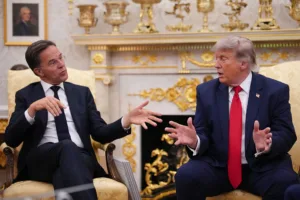

Germany’s Federal Chancellor Friedrich Merz (Christian Democratic Union, CDU) has called his country’s nuclear phaseout “irreversible”, contradicting both his own party colleagues and nuclear energy experts.
Speaking to the press late yesterday after a meeting with Czech Prime Minister Andrej Babiš in Berlin, Merz said: “Preceding German governments have decided to phase out nuclear energy. The decision is irreversible.
“I regret that, but it is like that. Now we focus on the energy policy that we have, on optimising it. We have to build out the grid. We also need cross-border co-operation.”
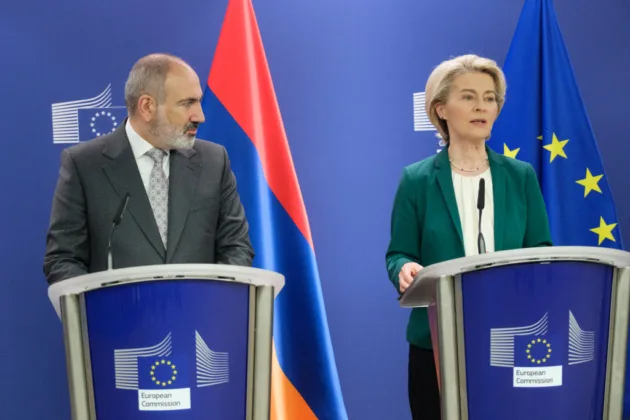
Merz remarks came after European Commission President Ursula von der Leyen had called the nuclear phaseout a “strategic mistake” at an IAEA summit in Paris – apparently oblivious to her enthusiastic support for shutting down Germany’s nuclear plants while she was a minister under Merz’ predecessor Angela Merkel (CDU).
“You will not be surprised when I tell you that I share Mrs von der Leyen’s view. But this has no consequence for Germany,” Merz added.
Merz’ defeatist attitude did not sit well with some members of his own CDU party.
Sepp Müller, deputy chairman of the CDU in the German Bundestag, said: “I very much welcome the remarks of EC President von der Leyen. Nuclear power has a future when we manage to build small and safe reactors that produce cheap electricity.”
Former CDU family minister Kristina Schröder also spoke out in favour of nuclear energy, saying Germany should abolish its legal ban on nuclear power and enable the construction of so-called small modular reactors (SMRs).
Ahead of the 2025 general election in Germany, the CDU had still touted plans to reactivate some of the decommissioned nuclear power plants. After the party agreed on a coalition with the Social Democratic Party (SPD), though, the return to nuclear did not make it into the coalition agreement.
Merz said at the time: “The SPD did not want that and we had to accept that.”
An end to the legal ban on nuclear energy would be possible with right-wing opposition party Alternative for Germany (AfD)– which is pro-nuclear – but Merz has ruled out any co-operation with the right-wingers.
Technically, some of the decommissioned plants should be salvageable according to experts.
A spokesman for German pro-nuclear NGO Nuklearia told Brussels Signal yesterday: “Some of the nuclear plants could be repaired and reactivated. There are several examples for that abroad. Reactivation conserves valuable expert knowledge and strengthens German industry.
“Also, a reactivation is mostly cheaper and faster than a new build since the building and parts of the equipment are already in place.”
Nuklearia urged that Germany should immediately stop further destruction of the nuclear reactors – which is still ongoing. Only in October 2025, utility company RWE blew up the two 160-metre-high cooling towers at the Gundremmingen nuclear plant.
Nuclear expert Rainer Klute told Welt TV: “We have nuclear power plants which are being decommissioned. This decommissioning is not irreversible. Of course a lot of damage has been done but technically it is possible to reverse that, and get nuclear power plants back online that are much cheaper than new builds.”
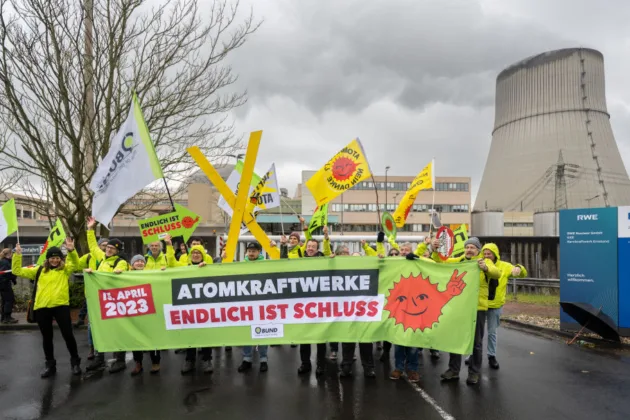
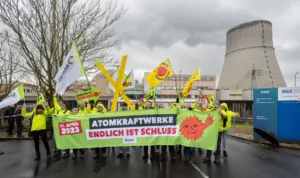
Germany decided in 2011, under then-Chancellor Merkel, to phase out all of its nuclear power plants by the end of 2022. After a last-minute extension due to the surge in energy prices following the Russian invasion of Ukraine in February 2022, the last three German nuclear plants went offline in April 2023.
Since then, the country groans under sky-high electricity prices. According to Eurostat, electricity prices for household consumers in Germany were the highest in the entire European Union in the first half of 2025. Non-household consumers such as business pay the fifth-highest prices.