



The Swedish State power company Vattenfall has announced that it selected candidates for the planned construction of a series of small modular reactors (SMR).
The move on August 21 marked the first phase of Sweden’s first nuclear power expansion in 50 years.
The Scandinavian country plans to build three to five SMRs, which will generate approximately 1,500 megawatts, equivalent to the output of two traditional large-scale reactors.
These will be built at the Värö Peninsula, where the Ringhals nuclear power plant is located, with plans to add another 1,000 MW in the future.
According to the Swedish Government, SMR’s require less space, need significantly fewer personnel and have more manageable logistics, making construction easier and keeping costs lower.
Vattenfall has shortlisted Rolls-Royce (UK) and GE Vernova (US) as potential suppliers, with a target completion date around 2035.
The energy company said that the two had “proven technology and simplified designs that have integrated knowledge from previous nuclear projects worldwide”. They both use fuel for which Vattenfall has established supply chains.
The plan is part of Sweden’s broader strategy to meet rising electricity demands, projected to double by 2045, and achieve a fossil-free electricity system by 2040.
The decision reverses a decades-long nuclear phase-out policy initiated after a 1980 referendum, driven by the need for stable, low-carbon energy to support “green” industries and energy security.
“It’s happening now – with new nuclear power, Sweden gets a more stable, competitive, and climate-friendly electricity supply,” said Swedish Prime Minister Ulf Kristersson.
“This is good for both Swedish families’ and industry’s economy. A big step is being taken by Vattenfall today after we have spent three years removing obstacles and creating conditions.”
Energy minister Ebba Bush, who has been a strong proponent of nuclear energy, said it “marks the start for Sweden in the global nuclear power race”.
“This is the beginning of something bigger, in many ways. The question is no longer whether we should build new nuclear power – but how quickly and how much.”
Nu händer det – med ny kärnkraft får Sverige en mer stabil, konkurrenskraftig och klimatvänlig elförsörjning. Det är bra både för svenska familjers och industrins ekonomi. Stort steg tas av Vattenfall idag efter att vi i tre år rivit hinder och skapat förutsättningar. Kika gärna…
— Ulf Kristersson (@SwedishPM) August 21, 2025
The government has also implemented around 50 measures to facilitate this expansion, including removing the previous cap of 10 reactors, streamlining permitting processes and developing a risk-sharing model to reduce financing costs.
Additionally, Sweden is considering lifting its uranium mining ban to leverage its significant deposits, which account for about 80 per cent of the European Union’s uranium reserves.
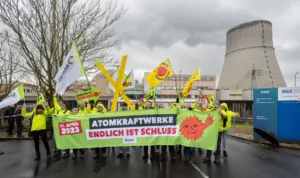
NGOs including Greenpeace have opposed the plan, arguing it lacks clarity on costs, timelines and permits while potentially delaying electrification and increasing emissions.
Desirée Comstedt, head of new nuclear power at Vattenfall, dismissed the criticisms and emphasised that the choice for small nuclear reactors was based on technical advantages.
“SMR suppliers build parts elsewhere and then assemble them on the site. This shortens construction time and reduces the need for labour – two of the most cost-driving factors in this type of project,” Comstedt told business magazine Affärs Världen recently.
She said arguments in favour of conventional reactors missed that SMR’s initially have the same lifespan of 60 years and that this can also be expanded, noting that the existing reactors originally had a 40-year lifespan when built.
Around one third of Sweden’s electricity generation comes from nuclear energy.
Czechia has joined the European countries in re-embracing nuclear energy. https://t.co/mF8y4G5aYJ
— Brussels Signal (@brusselssignal) June 5, 2025