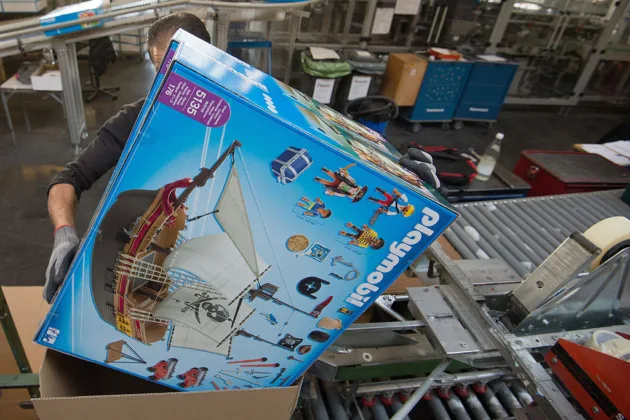






Ireland’s industrial production fell by 13.7 per cent in April, reversing a sharp 14 per cent surge in March.
The collapse, reported by Eurostat on June 13, was caused by volatile activity linked to multinationals, and it was now distorting how the eurozone’s economy appeared on paper.
Although Ireland made up just 4 per cent of the eurozone economy, it accounted for almost half of the bloc’s GDP growth in the first quarter of 2025.
The growth was not driven by domestic activity but came from global pharmaceutical and tech firms recording licensing income in Ireland, without producing or employing locally.

Ruben Dewitte, economist at ING bank, told Brussels Signal on June 17: “The phenomenon of contract manufacturing that distorted the Q1 Irish GDP growth number and subsequently the eurozone’s Q1 GDP growth number, also affects the industrial production numbers.
“Irish industrial production saw a 14 per cent increase month-over-month in March, followed by a 15.2 per cent drop in April, numbers that don’t reflect the actual activity on Irish soil.”
That part of GDP did not represent any real economic activity in Ireland, according to an ING analysis. It warned the effect would likely reverse in the second or third quarter, after April’s sudden drop in factory output.
The distortion has become increasingly significant as the eurozone’s industrial production declined sharply elsewhere.
According to Eurostat, the European Union statistical office, eurozone industrial output dropped 2.4 per cent month-on-month in April, driven partly by a correction after tariff-related front-loading earlier this year. Ireland’s collapse was a major contributor to that decline.
ING also noted in a June 12 report: “The presence of intellectual property rights in Ireland leads to licensing revenues being recorded there, inflating Irish GDP — even though much of this income is ultimately channelled away.”
The growing divergence between Irish headline data and underlying activity was now raising questions for policymakers.
Ireland’s domestic economy remained robust, with employment rising by 0.7 percentage points in Q1 2025 — seven times the EU average, according to Eurostat. Employment minister Peter Burke called it proof of the country’s “focus on fostering a vibrant economy,” while finance minister Paschal Donohoe hailed it as evidence that Ireland was “on the right track”.
But the Irish Government has become more cautious. “The mood-music is changing. It is not appropriate — indeed it could be dangerous — to plan on the basis of these receipts being permanent,” Donohoe warned at a business consultation event on June 16, Bloomberg reported.
He referred to the volatility of corporate tax inflows that have been heavily dependent on multinationals.
At the company level, business sentiment was also cooling. A May survey published by the Irish Times showed confidence among Irish businesses falling to its lowest level since the survey was launched a year ago.
Neil Hughes, CEO of international business advisory group Azets Ireland, said: “Irish business leaders are steering their organisations through one of the most uncertain periods in recent memory — where trade tariffs, geopolitical risks and economic uncertainty are increasing.
“This volatility is beginning to dent business confidence, with a marked drop in optimism since late last year.”
Meanwhile, across the eurozone the outlook remained clouded by ongoing trade tensions, rising energy prices and sector-specific struggles.
Matthias Janssens, Financial Markets Analyst at Belgian bank KBC, said: “European industry is suffering from a general economic slowdown.
“Higher interest rates, strong competition from abroad, higher energy prices after losing access to cheap Russian gas and weak exports are all weighing down on industrial production.”
For now, the statistical distortions from Ireland’s multinational-dominated data were masking some of these underlying weaknesses.
The European Commission’s Spring Forecast noted that the country’s domestic economy remained supported by solid consumer spending, public investment and strong participation in the labour force, particularly among women and younger workers, factors that had so far shielded the country from some of the broader eurozone slowdown.