
Brussels poured cold water on US demands for increased energy imports on April 8, saying it was both unrealistic and undesirable for the 27-member bloc.
Taking to press, a European Commission spokesperson said the EU did not want to become more dependent on US energy imports than it already was.
“We want to avoid over-dependence on any single supplier,” said Anna-Kaisa Itkonen, EC spokesperson for climate and energy, “we have learned our lessons too well”.
While not refusing US President Trump’s proposal outright while the bloc seeks to diversify energy suppliers from Russia, she stressed that “half of the EU’s LNG [liquefied natural gas] already comes from the US”.
And even if it wanted to, the Commission was in no position to make private sector companies draw up new contracts.
“The commission is not a market actor; we do not negotiate any of these contracts” she said.
For this reason, the EC is reportedly unable to give a precise number of the quantity of gas the EU could import, or even “any definite number that we have historically spent on US LNG, because we do not have access to these contracts”, Itkonen said.
What the EC can do is to “review permitting procedures for energy infrastructure and look into options [for] pulling demand”.
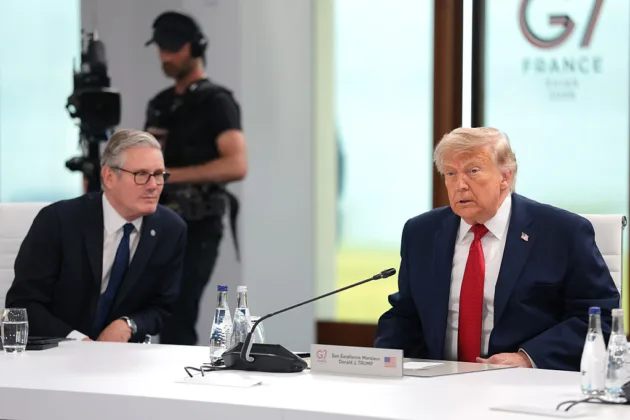
Trump has suggested he could drop tariffs directed towards the EU if the bloc imported 350 billion USD gas.
The energy demand came after Trump refused a “zero-to-zero” tariff offer, made by the EC on April 7, after a trade ministers’ meeting on US “liberation day” tariffs. EU countries were divided and did not agree to target US services in their retaliatory tariffs; officially, the main goal remains “a negotiated solution“.
On the topic of buying more US gas, Itkonen insisted the EU is “ready to discuss… ready to negotiate”.
But is still unclear what “being ready to negotiate” actually means.
EC spokesperson for trade, Olof Gill, emphasised that the timeline had to be “careful” and “calibrated”.
Member states are set to vote on April 9 on the proposed 25 per cent tariff: a response to the steel and aluminium tariffs announced by the US last month.
“The EU steel and aluminium tariff list was due to expire end March. We extended the suspension of that list until April 15, the hard deadline by which we have to impose our countermeasure, subject to approval by the Member States”, Gil said.
These 25 per cent would come into force “early next week”, or around April 15.
Answering questions about the decision not to impose retaliatory tariffs on US services, in particular big tech, Gil also said “the big bazooka is still on the table, but we are trying not to use it, because we are trying to avoid a big bang”.
The “big bazooka” or Anti-Coercion Instrument (ACI) is a legal mechanism for countering economic pressure from third countries.
The EU proposal for retaliatory tariffs is separate from the countermeasures on steel and aluminium, Gill said.
A response to the US decision to impose a 25 per cent on car imports, also announced on April 2, will be discussed at the same time as the answer to the global “reciprocal tariffs” on all industries.
The US has so far not targeted specific industries, but has imposed global tariffs affecting nearly all goods from most countries. After the April 7 Council, European Commissioner Maroš Šefčovič pointed out that the Trump administration is particularly focused on the “big five” sectors: pharmaceuticals, metals, lumber, semiconductors. The car sector is “symbolic”, he said.
Trump refused the “zero-to-zero” tariff deal on “cars, and other industrial goods”.
EU insistence that it boasted “the largest single market on earth” did not move the US leader. Itkonen reiterated this argument when offering to negotiate imports of American LNG.
Itkonen and Gil said the EU would prioritise agrifood, safety and the EU’s “green deal” standards.
The EU would remain an attractive market for both the US and “other partners” for LNG “for some time still”, press were told.
Meanwhile, EC President Von der Leyen had a call with China’s Prime Minister Li Qiang on the topic of a possible rapprochement on April 8.
Officially the EU is “de-risking” from China, complicating its diversification strategy further.
Gil stressed that “the idea was never to decouple” from China.
While accepting that the massive wave of US tariffs would “increase overcapacities”, the EU would continue to”reevaluate” its relations with the Asian giant.
To address immediate risks, Von der Leyen and Li Qiang discussed creating a mechanism to monitor trade diversion and ensure that any distortions in the market were addressed.
Anne-Laure Dufeal contributed to this reporting.