


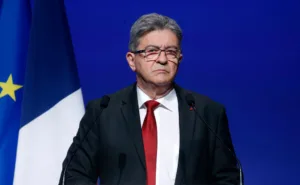


The French left-wing Green Party mayor of Grenoble, Éric Piolle, has been pushing for anonymous drug tests targeting France’s political elite, including ministers, senators and members of the National Assembly.
“I propose that saliva, hair and urine tests be conducted on ministers, elected representatives and political staff in the Assembly and Senate,” Piolle declared on February 3.
According to him, rampant drug trafficking in France has raised concerns about possible connections between criminal organisations and the country’s governing institutions.
He argued that the best way to unearth any such possibility was to test whether illicit substances were widespread within “decision-making circles”.
“It would be a way of seeing whether the problem is also affecting decision-making circles, which are supposed to be fighting drug trafficking,” Piolle said, pointing out that drug scandals had already been recorded in the French parliament.
In November 2024, hard-left MP Andy Kerbat was accused of using public funds to fuel his drug habit. He later admitted in a press release that he was indeed addicted and subsequently stepped down from parliamentary activities to go to rehab.
For Piolle, that seemed to be merely the tip of the iceberg.
“All studies show that cocaine use is widespread in France, not just for recreation but also as a coping mechanism for stress and unbearable lifestyles,” he claimed.
Speaking to Brussels Signal on February 5, “Alizée”, a social worker in reception and support centres for risk reduction for drug users who wished to remain anonymous, said Piolle’s ideas could backfire.
“If we find out that they’re [politicians] consumers, what does that say? What does that do?
“We’re talking about moral issues because before we found out, no one had complained that they were doing their job badly or that they were behaving in a bad way that was directly linked to consumerism,” Alizée said.
France’s ‘high society’ has apparently grown, as experimenting with drugs has soared. https://t.co/OZleBBxJls
— Brussels Signal (@brusselssignal) January 16, 2025
Piolle’s initiative was met with a scathing response from Minister of Justice Gérald Darmanin, who dismissed the idea and called him out for what he called the Mayor’s own failure to combat drug crime in Grenoble.
“If Éric Piolle wants tests, I’m happy to take them,” Darmanin said on February 5. “But maybe he should start with his own municipal council.”
He accused the Grenoble Mayor of pushing for full drug legalisation rather than tackling the crisis in his own city.
“Mr Piolle isn’t fighting drug trafficking in Grenoble. I saw it firsthand for four years as interior minister.
“He doesn’t just want decriminalisation — he wants full legalisation, which demoralises the police officers fighting the drug war in his own municipality,” Darmanin said.
He did, though, recognise that drug use touched every sphere of French society.
“It’s not just a question of local young people taking drugs. There are business lawyers, executives, journalists and politicians,” he said.
Piolle argued that the current official and regulatory approach had failed.
“The all-repressive system fuels traffickers, clogs the justice system and ties up police resources. We need to change our methods,” he insisted.
At the start of the year, he had urged President Emmanuel Macron to hold a referendum on cannabis legalisation — a move that if adopted would mark a radical shift in France’s drug policy.
That was despite the fact that France’s interior minister Bruno Retailleau had already launched a “war on drugs”.
Piolle is not the only European politician wanting legislators to be tested for drug abuse.
In 2023, Belgian hard-right Flemish party Vlaams Belang said its country’s politicians should be subject to an annual drug test.
Ahead of his visit to Marseille — a French city struggling with significant drug issues — France’s interior minister Bruno Retailleau has laid out his action plan to combat drug trafficking. https://t.co/fQjxNtO8PQ
— Brussels Signal (@brusselssignal) November 8, 2024