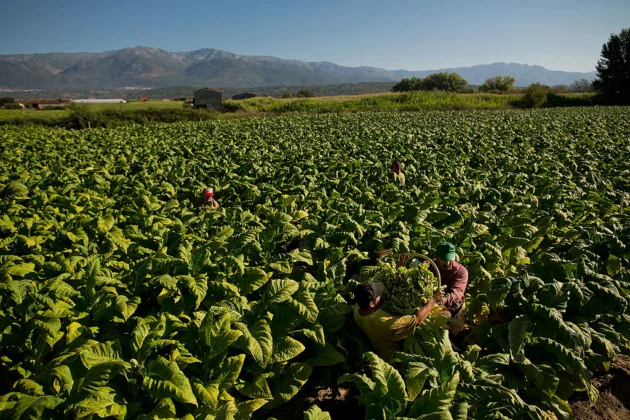





There is evidence to support protesting farmers’ claims that they are drowning in EU regulation, according to economists surveyed by Brussels Signal.
Above a certain threshold, regulatory costs outweigh their benefits, says Ana Boata, head of research at multinational financial services company Allianz Trade.
There is evidence this is true for farmers, she said.
Europeans have been enduring record high food-price inflation, but EU farmers’ real incomes have dropped by 12 per cent between 2022 and 2023, according to Allianz Trade.
In France, where there is relatively more regulation than the rest of the bloc, farmers’ remuneration dipped by 22 per cent in real terms.
Regulation has hit farmers’ productivity, which declined rapidly over the past five years across the EU – most notably in France.
“For instance, the Common Agricultural Policy [CAP] is increasingly imposing mandatory constraints in exchange for subsidies,” Boata said.
“Along with regulation, market forces also explain why so little of the increased costs we pay for food ends up in farmers’ pockets.
“Farmers are un-concentrated [i.e. fragmented] and, therefore, have low bargaining power,” she added.
“The extra euros we pay in food are more likely to stay with the supermarkets, which can drive hard bargains with the farmers they buy food from.
“Animal growers – producing meat, milk, and eggs – have held up better here than growers of non-animal products like wheat, grain, and oil,” Boata continued.
“Despite not getting more money for the food they sell, farmers have still needed to fork out more, in higher costs for energy, fertiliser, transportation, storage and their workers’ wages.
“While this is hardly the first time that Europe has faced farmer protests, they could play a role in the upcoming European elections,” she added.
There is a “rise of a new kind of agrarian populism” in Europe, Boata contended.
As an example she pointed to the Netherlands, where the BoerBurgerBeweging, or Farmer-Citizen Movement, grew out of protests in 2019 on its promises to address farmers’ issues.
After gaining the highest number of seats in May 2023’s Dutch Senate elections and 4.7 per cent of votes in November’s General Election, the party is now in talks to be part of the ruling coalition.
Boata said that governments could increase their efforts “to ensure that farmers are paid fairly along the distribution chain”.
The EU, for its part, could look for ways regulations could be “simplified and streamlined”, she added.
Oxford Analytica predicted on January 31 that Farmer protests in Paris and Brussels that began on January 18 “are likely to spread to more countries, such as Spain and Portugal”.
The French protests are the country’s Prime Minister Gabriel Attal’s first crisis since taking office January 9.
Attal has responded by addressing grievances of small farmers in France’s Southwest, promising to abandon new diesel taxes, simplify environmental rules and pressure supermarket chains to offer “fairer prices” to farmers for their produce.
Those farmers with larger cereal holdings nearer Paris, especially the Fédération nationale des syndicats d’exploitants agricoles (FNSEA), or National Federation of Agricultural Holders’ Unions, rejected French President Emmanuel Macron’s promises. They launched the recent tractor-powered “siege of Paris”.
Their beef is more with the EU, especially rules restricting use of pesticides near private housing, and a new policy requiring them to leave 4 per cent of their land fallow to permit nature to “recover”.
These grievances are harder for Attal to address, although Macron attempted to raise farmers’ concerns at an EU leaders’ summit on February 1.
The French farmers’ relative success in gaining concessions from Attal is likely to encourage agricultural workers elsewhere to protests, according to Oxford Analytica.
Spanish farmers have announced demonstrations, which likely will spill over to neighbouring Portugal ahead of its general election on March 10.
Such protests are growing more widespread – and inventive.
Dutch farmers sprayed liquid manure at the entrance to the Utrecht provincial government building on February 2 and did the same at an Aldi supermarket on February 3.