


China and the European Union have exchanged verbal blows at the World Economic Forum amid ongoing tensions over trade.
Chinese Premier Li Qiang and European Commission President Ursula von der Leyen put forward rival views on January 16 about who and what is damaging international relations today.
Addressing international political and business leaders, Qiang criticised attempts by some global powers to restrict trade for “political means”, especially regarding technology.
The senior Chinese Communist Party member in particular highlighted what he described as attempts to limit the worldwide trade of “green” technology as being a source of international tension.
“Talks about the need for stronger co-operation on climate governance are often accompanied by actions of erecting barriers to green trade,” he told the WEF conference, complaining that some “high-quality and efficient green and low-carbon technologies and products cannot flow freely” because of what he said were such restrictions.
This seemed to some to be be a veiled jab at the EU, which is currently examining whether or not to impose restrictions on Chinese solar panels and electric vehicles. Both considerations have previously provoked accusations of “unfair” European protectionism from Beijing.
The European Commission has admitted it is again concerned about apparent Chinese attempts to undermine the European Union’s solar energy industry. https://t.co/ukAzZEfABW
— Brussels Signal (@brusselssignal) November 17, 2023
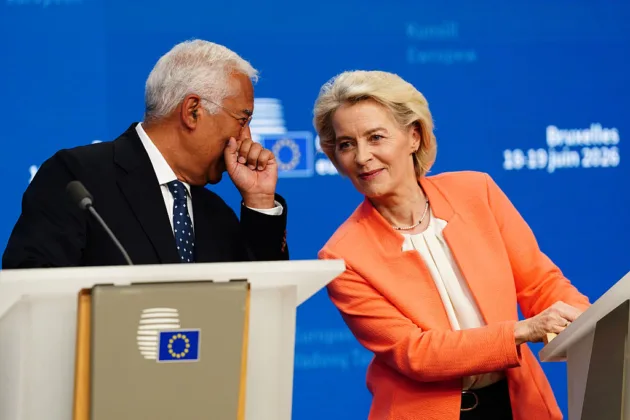
While Qiang appeared to think it best not to mention the EU by name, Von der Leyen seemed less diplomatic in her speech.
Addressing the crowd straight after Li, she explicitly accused China of “harming” international trust by imposing export restrictions on certain rare-earth materials.
“The fact that China has started to prepare export controls on germanium, gallium and graphite now was not trust-building,” she said.
Von der Leyen added that the EU was pursuing a policy of “de-risking” from China and, while it did not want to end trade with it completely, the bloc aimed to ensure it was no longer reliant upon Beijing at all.
“If you look at China over the last 10 to 15 years, China has systematically reduced its reliance on – and over-dependency on – the world, and increased our dependency on China,” she said.
“On that, we have to be very frank and very open.
“It is always better, I think, to address problems – because then you can solve them.”
China will halt the export of a range of rare-earth technologies, potentially making it harder for the US and its allies to bolster Western supplies of strategic raw materials. https://t.co/libqTYVJ07
— Brussels Signal (@brusselssignal) December 22, 2023