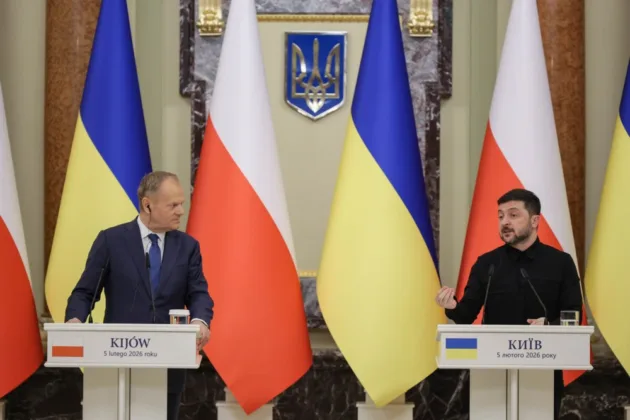







Donald Tusk’s opposition Civic Coalition (KO) together with the centrist Third Way coalition and the Left look likely to win a majority in the Polish Parliament, according to exit polls.
The IPSOS exit poll for Poland’s main TV networks, confirmed by voting data from certain precincts, showed PiS topping the poll with 36,6 per cent ahead of the KO on 31 per cent, Third Way with 13,5 per cent, the Left 8,6% and Confederation 6,4%.
In terms of the distribution of seats in the 460 member Lower House (Sejm) the projections as of the morning of October 16 were 198 seats for PiS, 161 for KO, Third Way 57, the Left 30, and Confederation 14.
The three opposition parties (KO, Third Way and Left) have made clear they want to form a government together. None of them looks likely to be a potential partner for PiS.
The party that could have been such a partner, the right wing Confederation party, which on migration, the EU and identity issues is close to PiS, had a surprisingly poor result of just over 6 per cent.
The stronger than expected showing of both the KO and Third Way, together with the fact that the vote of the Left party held up, looks to have given the opposition a majority in Parliament.
Since PiS won the most votes and seats it is likely that President Andrzej Duda will call upon that party to form a government. However, it looks unlikely that such an attempt will be successful given the above arithmetic.
While opposition parties should be able to form a government, their ability to push through a legislative programme will be limited by the fact that they will not have the 60 per cent of seats required to overturn the President’s power of legislative veto.
The turnout, projected to be 73 per cent, would be a record for Polish democracy.
On the other hand, only 40 per cent of voters participated in the referendum held on the same day as the election, meaning the results will not be binding. Those who took part overwhelmingly backed the government’s policies on migration, privatisation and the age of retirement, it would seem.
According to Jarosław Kaczyński, leader of the ruling party, this was the fourth time his party topped the poll in a parliamentary election and the third in a row which was, he said, a “great success”.
Kaczyński said it was too early to predict whether the result would enable the party to continue in office and promised that PiS would not allow for “Poland to be betrayed.”
In a hint that he expected the formation of the new government to be tricky, he added that his party and Poland now faced days of tension and urged the party faithful to wait for events to unfold.
The leader of the Civic Coalition, Donald Tusk, speaking to his followers on election night, said that he had never been happier at coming second because the overall result meant that “we have removed them [the PiS] from office.”
He hoped that as a result of the high turnout the final result might be “even better” for his party and the opposition as a whole. He said he was certain that this was “the end of PiS rule”.
One of the leaders of Third Way, Władysław Kosiniak-Kamysz, claimed that without the strong performance of his electoral alliance there would have been no opposition victory. His partner in the alliance, Szynon Hołownia, said the result marked “the end of rows and give-aways and the beginning of cooperation and investing in our future” with Third Way as the “anchor for democracy” in Poland.
Sławomir Mentzen, one of the leaders of the Confederation party, admitted defeat in that his party had failed to turn the tables on both government and opposition.
According to psephologist Marcin Palade, writing on X, the ruling party lost because it “deserted the centre ground made up of voters who were not Eurosceptic and not particularly interested in identity issues, to the Third Way alliance”. While PiS may have managed to marginalise its rival on the right, the Confederation party, by doing so it lost a potential coalition partner in the new parliament, Palade said.
Łukasz Warzecha, commentator for weekly newspaper and online portal DoRzeczy, said the Confederation party had failed to deal with its “internal problems” and had over-concentrated on the fickle youth vote. Once its main policies on tax cuts and a less supportive line on Ukraine had been stolen by other major parties, Confederation found itself in retreat.
Social scientist Rafał Chwedoruk told commercial radio TOK FM that the big loser of this campaign was prime minister Mateusz Morawiecki. “He is now unlikely to lead PiS should Kaczyński retire, nor to be the party’s candidate in the presidential election in 2025.”
Daily newspaper Rzeczpospolita wrote in an editorial that PiS fell short because it had “no distinctive proposals, since social transfers [such as child benefit] had become accepted, even among the opposition parties”. He said that Third Way succeeded because some KO voters gave Third Way a tactical vote out of fear that the alliance would fall under the eight per cent electoral threshold, leading to a defeat for the the opposition in its entirety. The strong performance if Third Way leader Szymon Hołownia also helped, he said.
Wiktor Świetlik, commentator for portal Interia, said he feared the new government would be tempted to concentrate on fighting with the pro-PiS president and the head of the central bank because Donald Tusk will not be able to deliver on his promises to increase public sector pay and cut taxes.
The PiS ignored young voters and failed to convincingly deal with scandals involving its officials, he said.