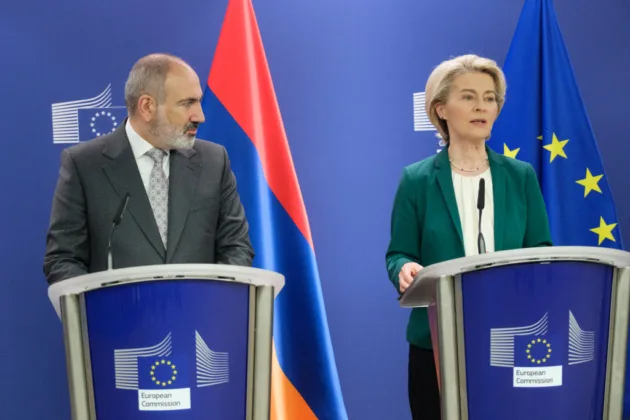
European Commission President Ursula von der Leyen made a case for subsidising nuclear technology at the Green Deal Summit in Prague on September 26.
Von der Leyen said the Czech choice of energy mix is and will remain a “national prerogative” and that nuclear plays a “central role” in Czechia’s energy system.
“We are always willing to consider state aid, of course provided the conditions are right,” she said, adding that the EC supported cutting-edge nuclear technology under the Net-Zero Industry Act.
In his opening speech at the summit, Czech Prime Minister Petr Fiala said that without innovation the European Union risked losing out to foreign competition. He said the name “Old Continent” regarding Europe could take on a new meaning in the global economy.
Fiala emphasised that, while the goals of the Green Deal are being met in terms of changing responsible behaviour towards the environment, the ambitions in terms of innovation and economic transformation are not.
The EC President’s stance seems to be a shift in favour of France, which advocates nuclear power as an energy source. That is despite the Commission’s previous hesitancy to embrace the technology, with Dutch “Green Pope” Frans Timmermans having been somewhat dismissive of it.
At a press conference in March, Timmermans told pro-nuclear Member States not to “make an ideological choice” but “do the maths”, stating that “renewable energies are getting cheaper almost every day, which is not the case for nuclear”.
Originally, the new industrial strategy under the Net-Zero Industry Act, which was the result of the Green Deal Industry plan and aims to scale-up clean technologies in the EU, barely mentioned nuclear energy.
It only spoke of “advanced technologies to produce energy from nuclear processes with minimal waste” and talked about “small modular reactors”.
Now Timmermans has quit the EC to return to his home country, there seems to be more wriggle room regarding nuclear energy.
There is much that remains up in the air, though. Countries such as Germany and Spain vehemently oppose nuclear energy, invoking fears over radioactive waste and nuclear disasters, despite scientists refuting such concerns.
On nuclear energy and car manufacturing, the Czech Republic has pushed hard against the EC’s initial plans, relying on nuclear power plants to produce more than a third of its electricity production.
It has also worked in concert with seven other EU countries to soften the rules on vehicle emissions, so “they do not jeopardise the competitiveness of the [vehicle manufacturing] industry”.
Von der Leyen praised the watered-down vehicle emissions compromise, the new Euro 7 pollution standards. She said the agreement was a“good compromise”.
Czechia has everything it needs to become a ?? leader in the clean economy
The EU is investing in turning Czechia's coal regions into hydrogen valleys. This will create thousands of jobs.
This is what the #EUGreenDeal, our growth strategy, is all about↓ https://t.co/iZxQ563M93
— Ursula von der Leyen (@vonderleyen) September 26, 2023