The European Union has “failed” in its attempts to appropriately manage relations with Armenia and Azerbaijan over the conflict in Nagorno-Karabakh, a senior German Government politician has said.
Michael Roth, an MP who serves as the chair of the Bundestag Foreign Affairs Committee, has now warned that Azerbaijan could soon preside over a “genocide” in the region.
“The EU strategy of equidistance between Armenia [and] Azerbaijan has failed,” he wrote online.
The EU strategy of equidistance between Armenia + Azerbaijan has failed. We must now act quickly + decisively to prevent ethnic cleansing in Nagorno-Karabakh + an attack on ?? territory. This is the only language that autocrats like Aliyev understand: ? 1/4
— Michael Roth – official ?????? (@MiRo_SPD) September 20, 2023
Roth also lashed out at Azerbaijan’s President Ilham Aliyev whom he accused of being an “autocrat”.
“We must now act quickly [and] decisively to prevent ethnic cleansing in Nagorno-Karabakh [and] an attack on [Armenian] territory,” the Social Democratic Party (SPD) politician said.
“This is the only language that autocrats like Aliyev understand.”
Speaking to Brussels Signal, Armenian Ambassador-designate to the EU Tigran Balayan also criticised what he called a lack of action from Brussels, although he insisted that it could still act to prevent the situation from getting even worse.
“The EU could have done more by introducing early warning and preventive sanctions against responsible Azerbaijani officials and MPs who were propagating for war and ethnic cleansing,” he said.
“We do think that still the EU has a full toolbox in its possession to prevent the further deterioration of the situation.”
A demand for sanctions on Azerbaijan initially appears unlikely to be met considering the EU’s current geopolitical situation.
Having attempted to wean itself off Russian fossil fuels, the EU has become increasingly reliant on exports sourced from Azerbaijan, signing a gas supply export with the country last year.
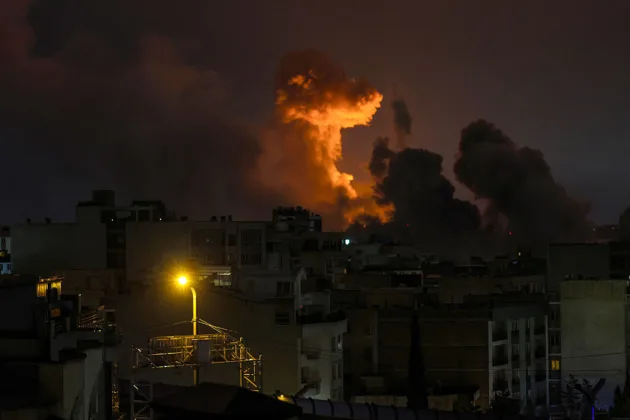
Azerbaijan said it was executing an “anti-terrorist operation” and launched attacks against several targets in Nagorno-Karabakh. https://t.co/rMENGfevMW
— Brussels Signal (@brusselssignal) September 19, 2023
Roth also said that he cautiously welcomed the recently announced ceasefire in Nagorno-Karabakh but insisted the truce “should not be used to displace civilian population” in the contested area.
Coming on the second day of the latest hostilities, Azerbaijan has claimed that the deal involves ethnic-Armenian forces laying down their arms in the region and dispensing with their military and paramilitary forces there.
This has been characterised by officials in Azerbaijan’s capital Baku as a “surrender”. They also say Russian peacekeepers will facilitate the surrender of weapons and ammunition to Azerbaijani forces.
Armenia has claimed that it has nothing to do with the ceasefire, with the country’s Prime Minister Nikol Pashinyan complaining that the agreement incorrectly references Armenian Armed Forces as being stationed in the region.
“We have numerously said that Armenia doesn’t have an army in Nagorno-Karabakh since August 2021,” he said.
Russia has confirmed that it will be presiding over the ceasefire, with a statement from the country’s defence ministry saying it is currently looking after 2,261 civilians at its base camp in Nagorno-Karabakh.
After nine months of blocking the borders, Azerbaijan has allowed humanitarian aid into Nagorno-Karabakh. https://t.co/v7Bsi0lVva
— Brussels Signal (@brusselssignal) September 13, 2023