



Ethnic Armenians fleeing Nagorno-Karabakh are making a “personal choice”, according to Azerbaijan’s Ambassador to the European Union.
In an interview with Brussels Signal, Ambassador Vagif Sadigov insisted that reports of ethnic cleansing and attacks on civilians in the region were a “blatant lie”.
“The issue of people fleeing, this is – you have to understand – this is a personal choice,” he told head of news Justin Stares.
Sadigov added that the Azerbaijani Government did want ethnic Armenians living in the region to stay, insisting that the country sees those leaving as being its citizens.
“We made messages to them through their mobile phones. We made the appeal through the foreign minister. Just two days ago President [Ilham Aliyev] himself on the public level said ‘please don’t leave’,” he said.
Azerbaijan, he added, aims to provide “all the assurances or guarantees” regarding the safety of those living in the region.
When asked whether dual Armenian-Azerbaijan citizenship would be possible for those returning, the ambassador was a little more hesitant, saying that while such an eventuality was technically possible, the constitution of his country “does not envisage” dual nationality arrangements.
The Armenian ambassador to the EU has rejected claims that Nagorno-Karabakh Armenians have no reason to fear the Azerbaijani occupation. https://t.co/4ZuLpwYdmf
— Brussels Signal (@brusselssignal) September 28, 2023
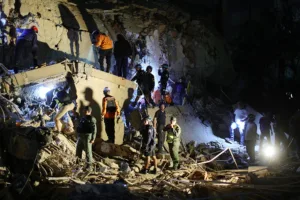
Since the beginning of Azerbaijan’s military operation in Nagorno-Karabakh earlier in September, tens of thousands of ethnic Armenians have fled the region into neighbouring Armenia.
As of writing, Armenia claims that around 88,000 ethnic Armenians from the disputed nation have arrived in its territory.
This could represent as much as two-thirds of Nagorno-Karabakh’s Armenian population, although Azerbaijan has disputed these figures, with Sadigov saying that there were not 120,000 Armenians in the region in the first place. The true number was unknown, the ambassador said.
The region’s ruling de facto government has worked to keep migration routes open for those fleeing the conflict. The region’s authorities claim that they agreed to dissolve their disputed Republic of Artsakh in order to ensure safe passage for the refugees, he said.

With the collapse of the Armenian enclave, attention is now shifting towards the Zangezur corridor in Armenia proper.
Separating Azerbaijan from its Nakhchivan Autonomous Republic region, the Armenian-controlled sector appears to be being eyed up by Azerbaijan and its ally, Turkey.
Meeting in the region, Aliyev and Turkish President Recep Tayyip Erdogan appeared to suggest Armenia hand over part of the corridor to Azerbaijan.
This would directly connect both Nakhchivan and Turkey with the main territory of Azerbaijan, as well as sever Armenia’s sole land border with its tentative ally Iran.
Sadigov firmly rejected such a characterisation, saying that while Azerbaijan does seek to open a transit corridor between its exclave and the rest of the country, it does not aim to annex any part of this corridor from Armenia.
“Not the President of Azerbaijan, not any single representative of the government of Azerbaijan never said that this railroad once it’s become functional, would be a part of the territory or would get into the jurisdiction of Azerbaijan,” he said, adding any claim to the contrary was a “complete lie”.
The full video interview with Ambassador Sadigov is now on the Brussels Signal website.
“The membership of the Republic of Azerbaijan in the EU and in NATO is not envisaged. It is not on our agenda,” Azerbaijan’s ambassador to the EU, Vagif Sadigov, said during a visit to the Brussels Signal studios. https://t.co/9DDd8d4nSC
— Brussels Signal (@brusselssignal) September 22, 2023