




Industry executives have warned that Germany has entered a phase of “de-growth” dominated by nosediving industrial production.
Despite de-growth being hailed by many environmentalists, few in Germany seem happy.
In an interview with Bild, German bosses said the country’s economy has been declining for more than 25 years and is now suffering greatly.
“The last glimmer of hope was the reforms under Chancellor Schröder [1998-2005], after which the country and its prosperity were … used up,” said Ulrich Schumacher, the former head of semiconductor giant Infineon.
“Not much remains of the economic ‘wonderland’.”
Wolfgang Reitzle, who has headed several of Germany’s top manufacturing companies, wrote in Die Welt that German infrastructure was “a disgrace”.
“With excessive bureaucracy, the state’s inadequate service to citizens stands in stark contrast to the ever-increasing tax burden.”
He also said there was a lack of desire among many officials in the country to make efforts to reverse the situation. According to Reitzle, the problem begins in school, where he said educational results are also tanking.
Janna Ensthaler, another entrepreneur and one of the most influential businesswomen in the country, blamed the government and the current “green” economy minister Robert Habeck.
“The federal government’s energy policy endangers Germany as a business location, overburdens and frightens ordinary citizens,” she told Bild.
Jürgen Geissinger, the head of car supplier Schaeffler until 2013, said: “Currently there is no recognisable industrial policy.” He called for tax cuts and new incentives for innovations developed in Germany.
Adding to Germany’s economic woes is European legislation such as the move to phase out combustion engines, which is proving painful for German carmakers.
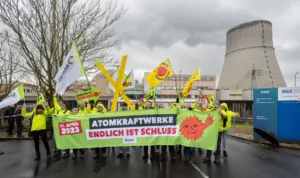
The country is also suffering because of a lack of cheap energy from Russia due to the Ukraine war and the closing of German nuclear power plants.
According to official data released on August 7, industrial production in Germany in June experienced a more significant decline than anticipated, indicating further deterioration in the manufacturing sector’s activity.
Germany, once known as the “economic powerhouse” of the Eurozone, witnessed a month-on-month drop of 1.5 per cent in industrial output, according to the federal statistics authority Destatis. Adjusted for seasonal and calendar effects, that was worse than the expected -0.4 per cent, and -0.1 per cent the previous month.
Furthermore, year-on-year German industrial production in June fell by 1.7 per cent, contrasting with zero per cent recorded in May.
“The drop in June provides a taster of the poor production figures that are on the horizon for the coming months,” said Commerzbank chief economist Joerg Kraemer.
He said the German economy was expected to contract again in the second half of 2023.