
Iran views Europe as a diplomatic minor player in the Middle East, Iranian officials and analysts told Brussels Signal during meetings in Tehran, arguing that EU rhetoric on Iran is often loud but carries little strategic weight.
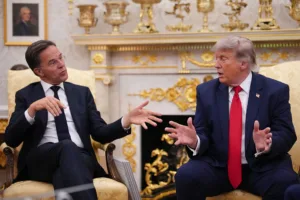
Multiple sources in the Iranian capital said recent calls by former Belgian Prime Minister Guy Verhofstadt and former Italian Premier Matteo Renzi for regime change have barely registered. While such statements resonate in Europe, Iranian officials see them as largely symbolic, reflecting Europe’s limited capacity to influence Iran and its dependence on the United States. For Tehran, Washington remains the primary interlocutor on strategic and security matters, with European capitals largely sidelined.
“An Iranian saying goes: When you enter a village, you must speak with the village chief. This sums up Tehran’s approach toward Europe,” said Davood Abbasi, an Iranian journalist and analyst who was a long time correspondent for the Italian news agency AGI. “Although European peoples have historically been seen as friends, today their governments are perceived as entirely aligned with the US and lacking independent interest in Iran. For strategic and security matters, it is necessary to engage with the United States rather than Europeans, who thereby miss a historic opportunity to exercise diplomatic influence.”
The perception of Europe as a side lined actor was reinforced in June 2025, when German Chancellor Friedrich Merz told ZDF that Israel was doing “the dirty work…for all of us,” adding he had “the greatest respect” for the Israeli government’s actions in carrying out strikes against Iran. In Tehran, analysts described this as a moment of maximum rupture.
Historically, the contrast is stark. In the decades following the 1979 Islamic Revolution, countries like Italy and Germany maintained strong ties with Tehran and could engage independently on political and economic issues. That credibility gradually eroded.
“A turning point came in 2011, after the Arab Spring, when European countries backed the United States in supporting extremist groups that infiltrated protests and, as in Syria, began targeting Iranian interests,” said Mohammad Ghaderi, a journalist and foreign policy analyst who previously directed the Tehran Times and now heads Mehr Media Group. Iran found itself fighting groups directly backed by the West and its regional allies, often with tacit European approval.
The culmination of this shift came in 2018, when the United States unilaterally withdrew from the Joint Comprehensive Plan of Action (JCPOA), meant to limit Iran’s nuclear programme. European governments publicly opposed the move but could not shield their companies from US secondary sanctions. Trade collapsed, and the EU’s INSTEX mechanism, meant to facilitate trade with Iran, remained largely symbolic until it was shut down in 2023. “That was the moment Europe lost us,” one Iranian source said. “They opposed Trump in words, but obeyed him in practice.”
Even amid direct confrontation—including the US withdrawal from the JCPOA and targeted strikes—Tehran continues to see Washington as the only actor capable of influencing strategic outcomes, and therefore the only possible interlocutor, even if an adversary.
“The Americans and Israelis carried out strikes while dialogue was still open,” Mohammad Ali Mirzaei, a professor at the Qom Seminary, told Brussels Signal, highlighting Iran’s lack of trust in them. Yet, with European countries having stepped aside from an independent position, Tehran considers engagement with the United States unavoidable.
Iran’s strategy appears clear: Strengthen itself as much as possible to defend and counterattack, but also to compel Washington to return eventually to the negotiating table. “Yet the stronger we become internally, the easier it is to compel them to negotiate,” Mirzaei said.
For Iranian analysts, this underscores a harsh reality: Europe cannot position itself as a meaningful interlocutor on Iran’s security and strategic decisions. Despite rhetoric and sanctions, European capitals remain side lined, while Washington alone shapes Tehran’s calculations.