

The European Union and Albania started new talks on the country’s accession to the bloc today, though signs from Albania’s neighbours in the western Balkans suggest public faith in EU membership is fraying and scepticism is increasing.
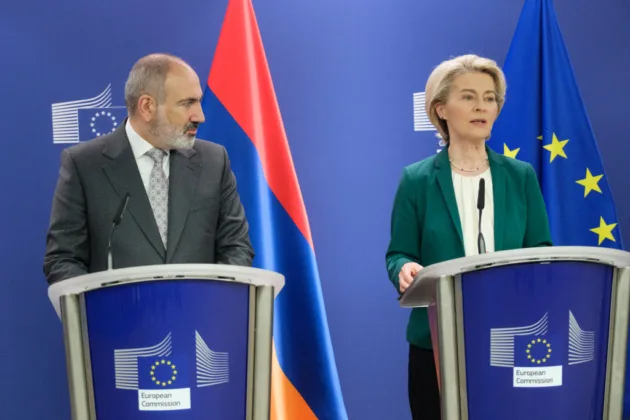
Today, speaking at a conference on Albanian accession process, European Commissioner Marta Kos, responsible for enlargement, thanked the country for its pace in accession talks.
Denmark’s Europe minister Marie Bjerre chaired the meeting for the European Council presidency, alongside Kos and Albanian Prime Minister Edi Rama.
The European Commission and Council say these talks are an important “step forward” in Albania’s process of joining the EU. Rama said they were aiming to complete technical work by 2027, as becoming an EU member does require many bureaucratic steps, even after completion of requirements.
The institutional progress made by Albania contrasts with weakening public belief in EU membership across the western Balkans.
Recent polling shows support for EU membership is highest in Kosovo and lowest in Serbia. Montenegro, North Macedonia and Bosnia show different levels of backing but Serbia stands out for its lack of belief that the EU is serious about enlargement.
The European western Balkans report found that fewer than half of Serbians now expect their country to ever join the bloc.
At a Brussels conference yesterday hosted by the Egmont Institute, speakers warned this credibility gap risks undermining the EU’s strategy in the region.
Yana Myachenkova, a researcher specialising in Balkan politics, said the 2004 enlargement round was “extremely fast compared to what’s happening now”.
She told participants that the current process is “technocratic and bureaucratic” and that “people from NGOs and students, who were the ones pushing governments to do reforms to join the EU, are the same ones who are losing faith that the EU is actually on their side.”
The conference also reviewed the economic effects of enlargement. A study by the Hungarian Oeconomus Economic Research Foundation marking Hungary’s 20 years in the EU found that “real wages doubled and poverty halved” between 2004 and 2023.
Hungary’s GDP per capita rose from about 59 per cent to 81 per cent of the EU average by 2022, the study said, although its authors warned that global shocks and war in neighbouring Ukraine could slow convergence.
The EC is due to publish its annual enlargement package in October, a set of reports that could update accession plans by laying out detailed roadmaps and benchmarks for each candidate country.
Hungary’s official for enlargement at its Permanent Representation to the EU, Karoly Gruber, noted that Serbia, North Macedonia and Bosnia and Herzegovina were promised EU membership a decade ago but remain stuck in slow-moving negotiations.