
The European Union’s foreign policy chief Kaja Kallas plus foreign ministers from the UK, France and Germany are to hold nuclear talks with their Iranian counterpart in Geneva.
The meeting on June 20 would come as European countries called for de-escalation in the face of Israel’s bombing campaign against Iran’s nuclear programme – and as US President Donald Trump weighed whether to join the strikes against Tehran.
“We will meet with the European delegation in Geneva on Friday,” Iran’s foreign minister Abbas Araghchi said in a statement carried by Iranian news agency IRNA on June 19.
US special envoy to the Middle East Steve Witkoff and Araghchi had spoken by phone several times since Israel began its strikes on Iran on June 13 in a bid to find a diplomatic end to the crisis, three diplomats, who requested anonymity, told Reuters.
According to the diplomats, Araghchi had said Tehran would not return to negotiations over its nuclear programme unless Israel stopped the attacks, which triggered continuing deadly retaliatory Iranian missile strikes across Israel.

European diplomats separately confirmed the planned talks, set to involve French foreign minister Jean-Noel Barrot, British Foreign Secretary David Lammy and German foreign minister Johann Wadephul, as well as Kallas, according to AFP.
“It’s better dealt with by way of negotiations than by way of conflict … The risk of escalation across the region is obvious,” UK Prime Minister Keir Starmer said on June 19, the Financial Times reported.
He added that the UK “completely” recognised Israel’s right to self-defence, “but the principle is that we need to de-escalate this”.
Barrot told journalists on the same day: “We have expressed our willingness to take part in negotiations aimed at securing from Iran a lasting rollback of its nuclear programme and its ballistic missile programme.

“Negotiation remains today the only way to achieve a lasting rollback of Iran’s nuclear and ballistic missile programme.”
The aim of the meeting would be to agree a framework to restart monitoring of Iran’s nuclear programme but with international monitors granted unfettered access to facilities. Another issue on the table would be whether Iran would be willing to make a commitment to cut its ballistic missile stockpile.
A crisis over Iran’s nuclear programme erupted after Trump unilaterally withdrew from the Joint Comprehensive Plan of Action (JCPOA), also known as the “Iran nuclear deal”, in 2018.
Tehran responded by expanding its activity and has been enriching uranium to levels close to weapons grade since, although it said its nuclear programme was purely for civilian purposes.
The Trump administration held five rounds of indirect talks with Iran before the diplomatic process was upended by Israel launching its strikes on June 13 — days before a sixth round of negotiations was scheduled.

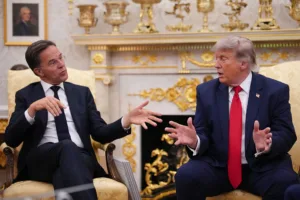
Trump has said there could be new talks with Iran in the “near future” and that he would decide whether to join Israel’s attack on the country “within the next two weeks”.
The statement by the US President on June 19 appeared to signal that he was slowing down his decision about entering the war, even as US military assets sped to the region amid fears of an imminent escalation, according to the FT.
“Based on the fact that there’s a substantial chance of negotiations that may or may not take place with Iran in the near future, I will make my decision whether or not to go within the next two weeks,” Trump said in a statement read by White House press secretary Karoline Leavitt on June 18.
Lammy was in Washington on June 19, where he was due to meet US Secretary of State Marco Rubio for talks focused on Iran, the US Department of State said.

Trump has said he was weighing military action against Iran’s nuclear facilities as Israel pummelled the country and Tehran responded with missile fire.
France, Germany, Britain and the EU were all signatories of the 2015 nuclear agreement with Iran struck by Trump during his first term in office.
Kallas, in co-ordination with European capitals, has insisted diplomacy remained the best path towards ensuring that Iran did not develop a nuclear bomb.
On June 18, French President Emmanuel Macron said European nations were planning to suggest a negotiated solution to end the Iran-Israel conflict. He has asked his foreign minister to draw up an initiative with “close partners” to that end.

Barrot has been in regular touch with his German and British counterparts since Israel launched its huge air strikes against Iran on June 13.
Speaking in Paris after talks on the crisis on June 18, Barrot added the three nations “stand ready to bring our competence and experience on this matter”.
Israel said its air campaign was aimed at preventing Iran from acquiring nuclear weapons.
Iran had been enriching uranium to 60 per cent – far above the 3.67 per cent limit set by the 2015 deal with international powers but still short of the 90 per cent threshold needed for a nuclear warhead, according to AFP.
Israeli Prime Minister Benjamin Netanyahu, who opposed the diplomatic efforts, said he launched the war to prevent Tehran developing nuclear weapons, the FT reported.