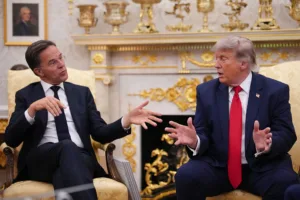

French President Emmanuel Macron has convened an emergency summit in Paris to forge a European response to the US policy shift over the war in Ukraine, although numerous European Union leaders will not be involved.
On the afternoon of February 17, only the heads of France, Germany, the UK, Italy, Poland, Spain, the Netherlands, Denmark, the European Union and NATO Secretary General Mark Rutte will discuss European security.
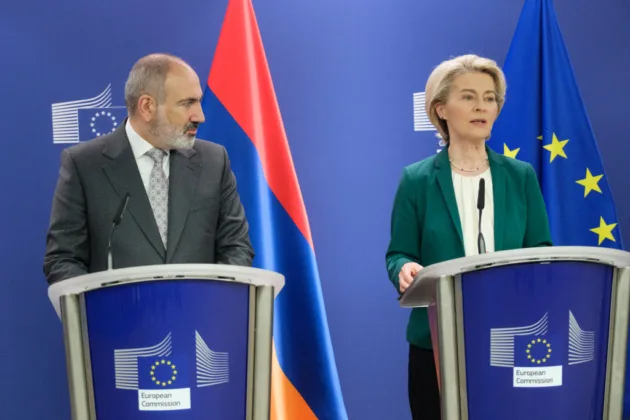
After US President Donald Trump announced he wanted to end the war in Ukraine, with little acknowledgement of the European point of view, the continent’s leaders declared a desire to show unity.
Following Macron’s announcement, though, several have criticised the fact that only a limited number of countries would be present at his summit in Paris.
Assita Kanko, a Belgian MEP for the European Conservatives and Reformists, said on the morning of February 17 on social media the French President was “discriminating against EU member states”.
“Macron is guilty of the very thing he accuses Donald Trump of — ignoring parts of Europe during these crucial talks,” she said.
She went on to question his authority following his recent electoral defeat: “What does the French President, who has long lost control in his own country, still have to say on the international stage — and on whose behalf?
“The meeting in Paris is pointless and only reinforces to the Americans that no one knows who should represent the EU in peace negotiations,” Kanko added.
“The chaos within the EU is making us irrelevant — on our own continent, no less.”
Romanian centrist politician and Mayor General Nicușor Dan wrote on Facebook: “The fact that Romania is not on the shortlist of guests, again is a very bad signal for us and is the result of an ineffective foreign policy.”
Spyros Litsas, an international relations professor at the University of Macedonia, said: “Macron’s decision not to invite all EU members to the Paris Summit reveals the problematic functioning of the Union at the highest level.”
On February 18, US and Russian representatives are set to meet in Saudi Arabia to launch peace negotiations. The US stated Europe would have no seat at the table, despite the talks directly affecting the continent’s security.
Earlier, US Defence Secretary Pete Hegseth sparked controversy by calling it “unrealistic” for Ukraine to reclaim its Russian-occupied territory or secure NATO membership. He further insisted that maintaining peace was Europe’s responsibility, not that of the US military.
European leaders have long pledged they would stand behind Ukraine as long as needed but, without US backing, that might become a difficult promise to hold; many European countries’ military forces have been significantly wound down in recent years.
On February 16, Reuters reported that the US had asked its European allies what they would need from Washington to participate in Ukraine’s security arrangements.
“The diplomatic demarche sent last week, consisting of six points and questions, also asks which countries could contribute to the guarantees, which would be willing to deploy troops to Ukraine as part of a peace settlement, and what the size of any European-led force might be,” the US security document read.
On February 16, UK Prime Minister Keir Starmer told British newspaper The Daily Telegraph he was “ready and willing” to put British troops on the ground in Ukraine to enforce a peace deal if necessary.
He said it was a “once in a generation” moment for national security.
Against that, the former head of the British Army, Lord Richard Dannatt, told BBC News on February 17 that sending soldiers to Ukraine would “come at a considerable cost”.
“Frankly, we haven’t got the numbers and we haven’t got the equipment to put a large force onto the ground for an extended period of time at the present moment,” he said.
“We’ve got to have the right number of people with the right equipment and the right training – and start to fund that now.”