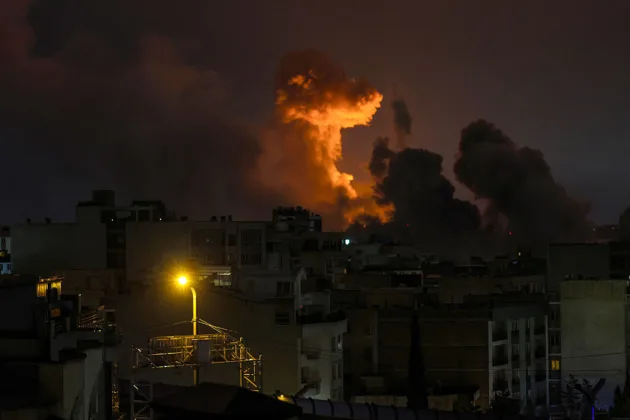




The European Union has “condemned” Iran’s ballistic missile strike on Israel and called for an immediate ceasefire across the Middle East.
“The dangerous cycle of attacks and retaliation risks spiralling out of control,” EU foreign policy chief Josep Borrell warned on X after the latest assault on October 1, 2024.
“An immediate ceasefire across the region is essential.”
The EU condemns in the strongest terms Iran’s attack against Israel.
The dangerous cycle of attacks and retaliation risks to spiralling out of control. An immediate ceasefire across the region is needed.
The EU remains fully committed to contribute to avert a regional war.
— Josep Borrell Fontelles (@JosepBorrellF) October 1, 2024
German Chancellor Olaf Scholz also condemned the Iranian missile strike in a statement on October 2.
He expressed concern that “Iraq risks igniting the entire region” and urged Hezbollah in Lebanon and the Iranians to halt their actions immediately.
Scholz pledged to collaborate with international partners to “broker a ceasefire between Israel and Hezbollah”.
French President Emmanuel Macron confirmed that his country has prepared its military forces stationed in the Middle East in response to the attacks, according to Spanish news agency EFE.
After a Defence and National Security Council meeting chaired by Macron, the Élysée Palace announced: “France has mobilised its military assets in the Middle East to counter the Iranian threat.”
On October 2, Iran declared that its assault — its largest on Israel so far — would not be repeated by the country unless further provoked, while Israel and the US vowed to retaliate, heightening fears of a broader conflict.
Iran stated that the missile strike was aimed exclusively at Israeli military installations. According to Iran’s State news agency IRNA, three military facilities were targeted, including Nevatim Air Base, a key logistical and air support hub for the IDF’s planned operations.

Reports circulating on social media amid the conflict suggested that a Mossad base in Tel Aviv was also destroyed, although no official confirmation has been forthcoming.
Tehran described its assault as a direct response to Israel’s recent attacks on its militant leaders and its aggressive actions against Hezbollah in Lebanon and Hamas in Gaza.
“Our response has concluded unless Israel provokes further retaliation. If that happens, our response will be even stronger,” Iranian foreign minister Abbas Araqchi warned in a post on X on the morning of October 2.
Earlier this evening, we exercised self-defense under Article 51 of the UN Charter, targeting solely military & security sites in charge of genocide in #Gaza and #Lebanon.
We did so after exercising tremendous restraint for almost two months, to give space for a ceasefire in… pic.twitter.com/SJJrAhxIdN
— Seyed Abbas Araghchi (@araghchi) October 1, 2024
US President Joe Biden affirmed full support for Israel, calling Iran’s strike “ineffective.” He revealed that, on the night of the attack, he had ordered the US fleet in the area to assist in intercepting Iranian ballistic missiles aimed at Israel.
Despite international calls from the UN, the US, and the EU for a ceasefire, hostilities between Israel and Hezbollah in Lebanon continued on October 2.
Haim Regev, the head of Israel’s Mission to the European Union and NATO, has warned that Europe will “pay the price” should Israel fail to defend its interests in the Middle East. https://t.co/g04Vo1QHQO
— Brussels Signal (@brusselssignal) October 1, 2024