


The Hungarian Government has responded to criticism from the European People’s Party (EPP) in the European Parliament of Budapest’s new visa policy for Russian and Belarusian citizens.
Hungary has recently expanded its “national card” immigration programme to include citizens from Russia and Belarus, among others.
Holders of this card are permitted to work in Hungary without security clearance and can bring their families, with the card being valid for two years and renewable thereafter.
This move, according to the EPP, could potentially exacerbate espionage activities within the European Union.
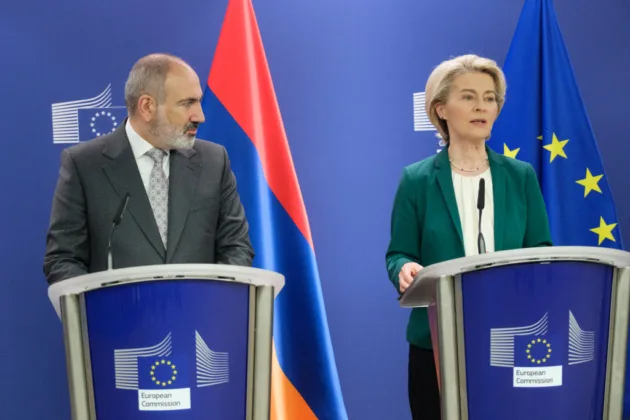
Manfred Weber, the EPP chair, has communicated these apprehensions in a letter to Charles Michel, President of the European Council. Weber emphasised that the new Hungarian regulations might “create grave loopholes for espionage activities … posing a serious risk to national security”.
The EPP chief further warned that the policy could facilitate easier movement for Russians within the borderless Schengen area, effectively circumventing EU-imposed restrictions.

The letter, first reported by the Financial Times on July 30, underscored growing tensions between EU institutions and Hungary, which currently holds the rotating Presidency of the Council of the European Union.
Hungary’s foreign minister, Péter Szijjártó, responded robustly to the criticisms.
On his Facebook page, he labelled accusations as “childish lies,” asserting that Russian and Belarusian citizens still required visas to enter Hungary and the Schengen area, and that residency permits were subject to authorisation by relevant authorities.
He accused the Baltic States of propagating “misinformation” and reiterated that Hungary’s procedures complied with European rules, which delegated such matters to national competence.
Additionally, Zoltán Kovács, Hungary’s Secretary of State for International Communication, described the EPP’s objections as a “hypocritical attack” on Hungary by the “pro-war liberal European elite”.
? In response to @ManfredWeber’s lies: This action is nothing but another hypocritical attack on Hungary by the pro-war liberal European elite.
?? Yet again, it is Manfred Weber who is attacking the Hungarian government, all the while his government and its political allies…
— Zoltan Kovacs (@zoltanspox) July 30, 2024
Kovács argued that, while the EPP criticised Hungary, it has simultaneously allowed millions of illegal migrants into Europe, posing significant security threats.
He insisted that Hungary maintained the strictest immigration regime in the EU, ensuring that so-called guest workers underwent national security checks and were only admitted under a tightly regulated framework and for a limited amount of time.
Polish deputy foreign minister Władysław Teofil Bartoszewski has said that Hungary could leave both the European Union and NATO and “create a union with [Russian President Vladimir] Putin and authoritarian States” instead. https://t.co/N7CQCv9QfT
— Brussels Signal (@brusselssignal) July 30, 2024