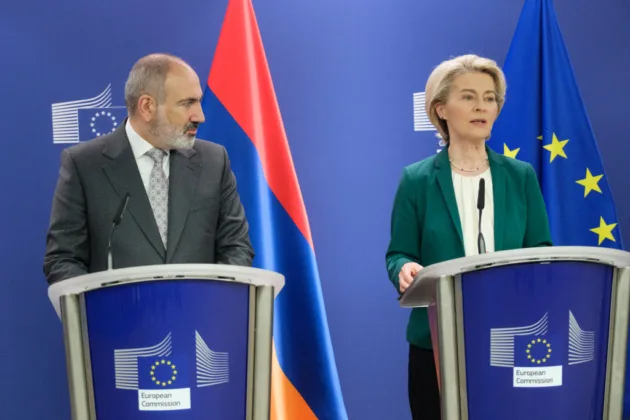







Ursula von der Leyen, on a February 23 visit to Warsaw, confirmed the European Commission will unblock Poland’s share of both the EU pandemic and cohesion funds.
The aid, totalling up to €137 billion, was frozen in a long-standing rule-of-law dispute with Poland’s previous PiS government. Von der Leyen said legislative reforms introduced by PM Donald Tusk were sufficient to release the funds, even though these bills are almost certain to be blocked by President Andrzej Duda.
At a joint news conference with Tusk, von der Leyen praised his attempts to restore the rule of law after what the European Commission describes as years of backsliding under the country’s previous government.
Tusk called the announcement “a great day for Poland” and Warsaw mayor Rafał Trzaskowski, also a member of Tusk’s Civil Platform party, said the new government had “succeeded where PiS had failed and secured EU money for Poland.”
The announcement about the unblocking of EU funds before Poland had yet delivered any concrete legal changes drew wry comments from the PiS opposition party.
“From a legal perspective nothing has changed,” said former justice deputy minister Sebastian Kaleta.
“This simply confirms that EU funds were an element of political blackmail that was to lead to a change of government in Poland,” said Jadwiga Wiśniewska, an MEP from the PiS.
The European Commission has consistently argued Poland’s previous conservative government, which in power from 2015 to 2023, brought courts and judges under political control and undermined the principle of checks and balances. It has withheld EU funds on those grounds.
The last PiS government however called its judicial policies legal and justified, saying they were to improve the functioning of courts and remove the influence of a “post-communist elite” that it said controlled them.
Previous prime minister Mateusz Morawiecki said the EU had political reasons to take issue with its approach: it did not want Poland to be ruled by a conservative government.
Similar judicial arrangements, with the legislature and the executive holding the judiciary to account, could be found in key EU member states such as Germany and Spain, he said.
The EC agreed a set of milestones with the previous PiS government, including changes in judicial reform legislation, but refused to release the funds until the legislation was put on the statute book and implemented.
The Commission decided to accept the Tusk government’s package of legislative drafts as the basis for unlocking the funds despite lack of guarantee they would actually become law.
On February 19, Poland’s justice minister Adam Bodnar attended a meeting of the EU’s General Affairs Council in Brussels.
Bodnar laid out a legislative plan to reverse many of the changes made by the previous PiS administration, drawing praise from the European Commission.
The minister outlined plans to introduce laws amending the status of the National Council of the Judiciary (KRS, the body responsible for judges’ qualifications), as well as the Constitutional Tribunal, the Supreme Court, and the common courts.
However, for these proposals to make it onto the statute book, they need to be accepted by the president. Duda holds a power of veto that can only be overturned by a two-thirds supermajority of parliament.
Since coming to office, the Tusk government has had a confrontational relationship with President Duda.
Tusk’s government defied his presidential pardons of two PiS MPs. It dismissed the head of the national prosecution service despite the law saying any dismissal and appointment must be approved by the head of state.
It also ignored his opposition to a takeover of public media, in contravention of current legislation on public media.
The present four-party ruling coalition Donald Tusk leads obtained 248 out of 460 parliamentary seats.
This is 28 short of a supermajority, and therefore lacks a realistic chance of overturning presidential vetoes.
President Duda is a close ally of PiS, which with 194 seats in parliament, can uphold any presidential veto.
Tusk’s government did not hold consultations with either the president or the PiS on its government’s legislative programme.
As a result, Duda has insisted on sending legislation to the Constitutional Tribunal for examination, though this is a body the present government deems to have been illegitimately constituted.