


The European Commission has unveiled new “economic security” proposals mainly aimed at managing European Union relations with China and aligning more with the US. Such new EU powers over export controls and outbound investments will prove controversial among Member States, experts told Brussels Signal.
Aimed at shielding Europe from China-developed new technology, the proposals revealed on January 24 would give Brussels added powers to “screen” European investments in China and control exported technology – powers some Member States would rather keep in their own hands.
Speaking to Brussels Signal, Gesine Weber, who researches European security as a Fulbright fellow at Columbia University, said that for an economic strategy, it was extremely “geopolitical, with many of the aspects directly or indirectly geared to manage relations with China”.
She said the EC proposals represented a “China policy wrapped in economic security policy,” and was “a reaction” to US President Joe Biden’s 2022 Inflation Reduction Act.
Weber said that was “a wake-up call that the EU actually needs a true industrial policy”.
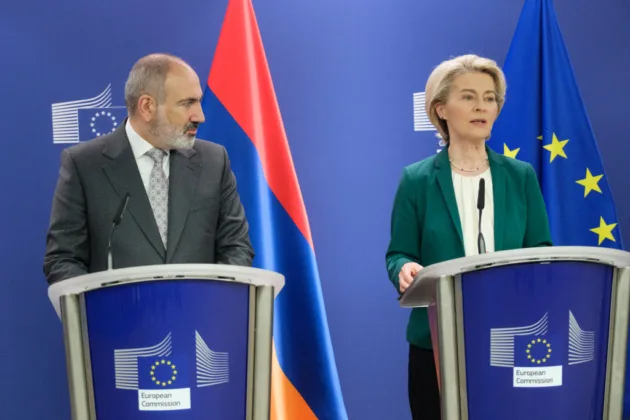
With European Parliament elections due in June, EC President Ursula von der Leyen’s bloc wants to portray the EU to voters as defending Europe’s economy against Chinese “threats”.
That is despite the fact that the European economy is performing markedly worse overall than either China’s or that of the US.
Growing by just 0.6 per cent over 2023 and probably in recession in the second half of the year, the Eurozone is sluggish compared to the US that notched more than 2 per cent growth and China’s plus-5 per cent in the same period.
Europe is also more dependent on imports for both energy and critical materials for its “green” and digital transitions.
The war in Ukraine and conflicts in the Middle East both have the potential to disrupt European trade and supply chains even further, the European Commissioner for Trade Valdis Dombrovskis said on January 19.
For the EC Executive Vice-President Margrethe Vestager, at least part of the answer is to give Brussels the increased powers proposed.
These aim to “protect our EU research and innovation from foreign interference” including “leakage or misuse”, Vestager said.
China’s rise has included buying key European businesses. The country’s home-appliances giant Midea bought German robot-maker Kuka in 2016 in a hostile takeover.
Midea then fired Kuka’s chief executive in 2018 and bought up the company’s last remaining shares in 2022.
Regarding the new proposals, with the strategy’s first benchmarks planned for late spring and early summer, “it’s clear that the Commission wants to push this as far as possible before the elections”, said Weber.
A challenge for the EU, though, will be linking up all its new different instruments, she added.
If Europe is going to “stop punching below its weight as a global economic actor”, its “big challenge” will lie in “better aligning and linking different EU instruments, like linking Economic Security to the Green Deal”, Weber concluded.
Von der Leyen may, in fact, be hoping the new proposals do not meet the same fate as her European Green Deal, which has stalled after provoking fierce resistance and accusations of “overreach”.
She may now also face fights on her new plans, both from Member States as well as Beijing, which has not yet replied to the proposals.
Antonio Barroso, a director with London-based consultancy Teneo, said there was already “reluctance in certain national [EU] capitals” over harmonising export controls.
The proposals on outbound investment screening “will probably prove more controversial”, he added.