



After winning praise at the COP 28 UN Climate Change Conference in Dubai for announcing €173 million in donations to multilateral climate funds, France’s President Macron has drawn criticism for “backtracking” on his environmental pledges at home.
Macron has been ambitious internationally in pushing for climate goals but, at home, he is constrained by budget deficits and opposition from French farmers, despite his protestations at December’s UN meeting in the Middle East.
In 2018, the UN named him a “Champion of the Earth” when he said there was “no Planet B” and, in 2022, he promised his second term would be “environmentally friendly or bust”.
A draft energy bill set to go to France’s Cabinet in February has drawn criticism for dropping any targets for solar and wind power and other renewables.
Environmental journalist Juliette Portala, who has written for Clean Energy Wire among others, said France “continues to lag behind its European neighbours when it comes to the rollout of renewables”.
The country, therefore, “now faces financial penalties for not taking any measures to make up for the 2020 gap towards its renewables target”, she added.
France’s Réseau Action Climat (Climate Action Network) posted on X that dropping a target for renewables was “regrettable” because “the challenge is to replace fossil fuel consumption as soon as possible”.
Nuclear power forms the basis of Macron’s draft bill but renewables “have a potential for faster deployment than nuclear”, added the climate body.
On the fossil-fuel side, France “was also found to be Europe’s largest supporter of major oil, gas and coal extraction projects”, Portal said.
In September last year, Macron pushed back closing France’s last coal power plants – originally scheduled for 2022 – to 2027.
This was despite the President previously urging other leaders at the May G7 summit to “commit to ending coal” before 2030.
“Macron must first sweep in front of his own doorstep,” wrote Greenpeace France on X.
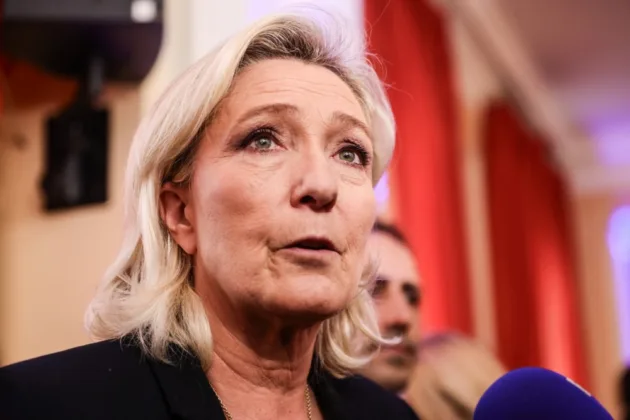
Macron’s coalition currently polls 9 percentage points behind Marine Le Pen’s Rassemblement National, which has seen environmental policy and immigration as a “wedge issue” to attract rural and suburban voters.
Le Pen has preferred “localism” and “common-sense ecology” to unpopular moves to change French people’s lifestyles and consumption patterns, while describing the “green” agenda as “the fight against humans”.
In this context, Macron has in recent months backed away from a number of his greener policies.
In May, the Government said it would prohibit short domestic flights for journeys that would take fewer than two and a half hours by train.
This ban has since been limited only to routes offering a direct train service running several times a day.
Macron also in May called for a “regulatory pause” in European Commission President Ursula von der Leyen’s Green Deal, saying Europe had “done more than most industrial powers” and now “needed stability”.
In September, the French Government said it would “no longer pursue” a ban on fossil-fuel heaters and would instead rely on incentives rather than coercion to move France towards more environmentally-friendly systems.
In December, it similarly discarded a planned reduction in motorway speed limits from 120kph to 110kph.
Macron’s environmental record may be perceived as somewhat better on less controversial matters, such as waste management.
Ceri Davies, a policy consultant in Wales who works on environment and renewables policy, told Brussels Signal: “E-waste is a big problem,” and Macron has been successful in “reducing it, encouraging longer use, recycling”.
Macron has “supported the end user rather than intermediaries,” thus “encouraging wider behaviour change in the population rather than higher up”, Davies added.
Still, on the issue of carbon emissions, renewables and fossil fuels, campaigners previously used to seeing the Élysée Palace incumbent as an ally in their fight against climate change now accuse Macron of “selling out”.
Independent bodies within his own Government agree that, to meet the EU’s carbon emissions targets, France will need to do more in the next seven years than it has in the past 33.
The country will struggle to meet its EU commitments for a 55 per cent reduction from 1990 levels of CO2 emissions by 2030, said the independent French governmental body Haut Conseil pour le Climat (High Council for the Climate).
Outside Government, campaigners are more frank; Greenpeace France called Macron’s record in office on climate change “une catastrophe”.