




France’s Senate yesterday voted to ban excessive “inclusive writing”. Senators argue it changes the French language, while making legal texts hard to understand.
The approved legislation bans inclusive writing in administrative documents, such as employment contracts, legal acts, company by-laws, and instruction manuals.
It also prohibits inclusive writing in France’s Education Code.
If administrative or legal texts are written in such language, then they would be considered inadmissible or null and void.
Excessive inclusive language “changes the French language and excludes people,” and “the Académie française is totally opposed to this way of writing and even expressing oneself”, says Les Républicains senator Pascale Gruny who tabled the ban.
“It’s starting to happen everywhere,” she adds.
The practice is “precisely contrary to inclusion,” posing an “additional constraint for people with disabilities, illiteracy or dyslexia,” Senate rapporteur Cédric Vial (LR) tells AFP.
“To be inclusive, we need to simplify the language,” says Vial.
The senators call for banning neologisms such as “iel”, a contraction of “il” and “elle”, or “celleux”, a contraction of “celles” and “ceux”.
The approved ban on inclusive language comes despite existing prohibitions on its use by a circular issued by former education minister Jean-Michel Blanquer in 2021.
Its use in official texts was banned by then-prime minister Édouard Philippe in 2017.
But despite these administrative bans, activists have still successfully pushed for the encroaching use of inclusive writing in much of society.
Senators on the Left, where the concept of inclusive writing is gaining popularity, are unhappy with the ban.
“This is an unconstitutional, retrograde and reactionary text, which is part of a long-standing conservative trend to combat the visibility of women”, said Socialist Party Senator Yan Chantrel before the vote.
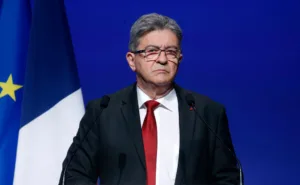
“The French language is a successful creolisation” and it “belongs to those who speak it!”, said Jean-Luc Mélenchon, leader of the hard-left La France Insoumise.
The town halls of Lyon and Paris, as well as several universities, use inclusive writing.
In May, a student union posted a University of Lyon exam using such inclusive writing online.
The family law exam given to first-year undergraduates included a case involving a non-binary couple referred to as “Touz* deux,” meaning “both”, rather than the more conventional “tous les deux“.
The protagonists were identified as Als*, highlighting the fact that they had “different gametes,” signifying their ability to “procreate through artificial insemination”.
To accomplish this, they required the assistance of health “professionaels”: a deliberate, “inclusive” spelling of the word professionals.
The Académie Française, France’s linguistic watchdog, warns of the danger of so-called inclusive writing, saying it confuses people and makes texts unreadable.
On Monday, just before the approval, French President Emmanuel Macron also weighed in on the matter during the inauguration of the ‘Cité internationale de la langue française’ in the restored castle of Villers-Cotterêts.
Emmanuel Macron set the tone, defending “the foundations” of language, “the foundations of grammar, the power of syntax” and inviting “not to give in to the zeitgeist” by adding “dots in the middle of words”. He said langauge was “the basis of who we are intellectually and of our relationship with the world”.